



Reducing carbon dioxide (CO2) emissions is globally argued to be a necessary condition to tackle climate change and achieve the principle of sustainable development [1]. Over the last three decades, CO2 emissions have been identified as one of the crucial issues in emerging economies. The amount of emissions in Indonesia tends to follow a positive trend, indicating a substantial annual influx of greenhouse gases released into the atmosphere each year [2]. This implies a significant impediment to achieving the Paris Agreement's objective of constraining the average temperature increase to 1.5 degrees Celsius [3]. Therefore, it is pivotal that policies aimed at the mitigation of CO2 undergo improvement.
Balancing economic growth and ecological sustainability is a complex and multifaceted undertaking for emerging countries such as Indonesia. Economic prosperity is globally argued as an underlying driver of air pollution degradation, including CO2 emissions [4]. An increase in per capita income leads to a scale-up in fossil fuel consumption, particularly for electricity generation and transportation, which, in turn, releases higher emissions [5]. The Stochastic Impacts by Regression on Population, Affluence, and Technology (STRIPAT) model posits a positive linkage between affluence, as a proxy for consumption levels, and anthropogenic CO2 emissions [6]. Prior investigations focusing on BRICS [7], Pakistan [8], and MENA countries [9] validated the linear nexus of CO2–income with various scores of elasticities.
Whilst economic growth corresponds to ecological depletion, the Environmental Kuznets Curve (EKC) framework posits that the detrimental impact of affluence on emissions exhibits a non-linear nexus. [10]. The effect of income on environmental depletion is not monotonically increasing; rather, it offers a technological effect after a certain income threshold [11]. The EKC framework implies that economic development can be applied as an instrument for pollution reduction. A past study utilizing panel 208 countries confirmed the presence of the inverted U-shaped linkage for an income-CO2 relationship, with an estimated Income Turning Point (ITP) of US$19,203 per capita [12]. Similarly, an empirical study in African countries recorded the EKC hypothesis with the ITP of US$5,702 per capita [13]. Nonetheless, another study in developing countries noted that the EKC hypothesis is not evident [14]. The existence of the EKC hypothesis is generally affected by numerous factors, including trade [15], energy consumption [16], and institutions [17].
Going further, there is significant growing attention to the impact of the monetary sector on the environment, such as credit and financial development [18]. Whilst credit is supposed to have a pivotal role in driving businesses, bank lending is also linked to ecological degradation [19]. Credit might serve as an underlying driver of environmental degradation by increasing emissions. In developing economies, financial credit is widely used for investment in carbon-intensive industries: fossil fuel generators, oil and gas extraction, and manufacturing operations [20]. Thus, an expansion of bank lending capacity may lead to a significant increase in CO2 emissions. Nonetheless, evidence in South Africa indicated that domestic credit is negatively connected to emissions from manufacturing firms and construction [21]. The detrimental effect of net domestic credit on emissions is not clearly discernible [22].
Building on the aforementioned background, this study intends to examine the interlinkage between private credit, economic growth, energy consumption, and environmental depletion in Indonesia by adopting the EKC hypothesis. This study offers empirical novelties regarding the impact of private credit on the environment. In the author’s current understanding, this research stands as a pioneering investigation of the interlinkage between credit and CO2 emissions in Indonesia. Whilst numerous studies investigated CO2’s determinants, none of them focused on the impact of private credit. Understanding the nexus between private credit and CO2 is pivotal to mitigating the damaging effect of financial markets and business expansion.
Regarding the estimation technique, the current study mainly relies on the Autoregressive Distributed Lag Bounds Testing (ARDLBT) [23]. The ARDLBT model is employed to provide the dynamic relationships and assess the cointegration relationship. It is also proper to estimate short- and long-run elasticities. Additionally, the Granger Causality (GC) test is included to examine the causal direction between variables.
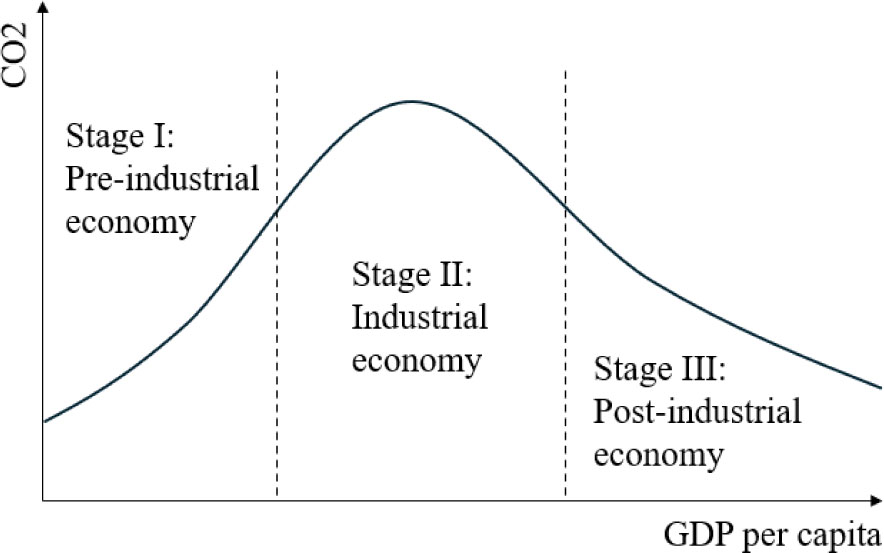
To discern the underlying factors contributing to environmental degradation (including CO2 emissions) from an economic standpoint, the STRIPAT and EKC models represent two widely adopted theoretical constructs. Whilst the STRIPAT model suggests a linear linkage between affluence and environmental depletion, the EKC model proposes a non-linear association [24]. The EKC hypothesis posits a relationship between economic development and emissions that aligns with distinct stages: the pre-industrial, industrial, and post-industrial phases [25]. It states that the damaging effect of economic growth on the environment exhibits in the early stage of development as a consequence of the scale effect [26]. After a certain threshold, a higher level of income generates ecological improvement on the grounds of investment in technology [27]. This stage represents the technological effect. Figure 1 depicts a schematic representation of the interlinkage between per capita GDP and pollution (proxied by CO2) within the framework of the EKC model. In practical terms, the EKC hypothesis applicability extends to various other indicators of environmental degradation, including deforestation [28], nitrous dioxide [29], methane [30], water pollution [31], biodiversity loss [32], and ecological footprint [33].
An illustration of the EKC hypothesis [27]
Numerous earlier studies have investigated the impact of economic growth on emissions under the EKC hypothesis, generally adding other factors into the empirical model to provide a more comprehensive understanding of the drivers of environmental change. For instance, an empirical study in Pakistan confirmed the EKC hypothesis and the importance of renewable energy consumption [34]. Similarly, the inverted U-curve association between income and CO2 and the advantageous role of green energy are validated in the context of developing countries [35]. Using yearly data for the period 1980–2020, a study in Indonesia provided corroborating evidence for the inverse U-curve association between income and emissions [36]. Nonetheless, the EKC hypothesis for CO2 was not validated in the case of Southeast Asia [37].
Within the EKC hypothesis, clean energy is expected to tackle the ecological depletion in the post-industrial phase. Whilst non-renewable energy usage is positively associated with CO2, renewable energy theoretically contributes to carbon mitigation [38]. Clean energy resources offer a pathway to decouple energy consumption from Greenhouse Gases (GHG) [39]. Thus, increasing energy use from renewable sources corresponds to a decrease in fossil fuel usage, which, in turn, leads to emissions reduction [40]. Relying on panel data from 163 countries for the period 2000–2016, the negative association between clean energy consumption and CO2 is robust and reliable [41].
Beyond the aforementioned factors, the financial sector is also argued to exert a moderating effect on emissions trajectories, with its operations and investment decisions potentially either exacerbating or mitigating environmental degradation [42]. Empirical evidence from Turkey highlighted a positive association between financial development and CO2, suggesting that the expansion of financial markets leads to environmental depletion [43]. Nonetheless, based on a panel of 88 developing countries over the period 2000–2014, financial development is noted to mitigate the adverse effects of income, trade, and FDI on emissions [44]. Furthermore, an empirical investigation encompassing European countries over the period 1985-2014 recorded the validity of the neutrality hypothesis between financial development and emissions [45]. An empirical study in Malaysia for the period 1971–2012 found a unidirectional causality running from financial development toward CO2 [46].
The main motivation of the current study is to assess the impact of private credit, economic growth, and renewable energy on the environmental quality, particularly CO2, in the context of Indonesia. Therefore, several econometric approaches are employed to provide comprehensive findings, including regression, causality, and the unit root test. The empirical model is based on the augmented version of the EKC model.
This study relies on Indonesia's annual series spanning 1980 – 2022; therefore, the length of observation is 43 years. The number of observations is sufficient for econometrics methods such as ARDLBT and the GC test. To establish multivariate analysis, CO2 serves as a response variable. The predictor variables under consideration include economic growth, private credit, per capita energy consumption, and renewable energy.
The response variable of CO2 emissions is expressed in metric tons. Economic growth is proxied by per capita GDP (constant 2015 $US). In addition, per capita GDP squared (YPC2) is computed to establish a non-linear model. Private credit is measured by total credit to the private non-financial sector, adjusted for breaks (% of GDP). Per capita energy consumption is measured in terawatt-hours (TWh). Renewable energy is proxied by the percentage of primary energy consumption from renewables. The datasets are gathered from Federal Reserve Economic Data (FRED), Our World in Data (OWD), and the World Bank Database (World Development Indicators-WDI).
The baseline model for the ECK hypothesis can be defined as Eq. (1) [47].
wherein CO2 signifies carbon dioxide emissions. YPC and YPC2 depict per capita income and per capita income squared. The term Ln is the operator of the natural logarithm. μ shows the error term. The subscript t represents that the data relies on a time series. Following previous studies, Eq. (1) is modified by integrating the impact of private credit and energy consumption. Therefore, Eq. (2) shows the empirical model.
wherein CRD stands for private credit. REU signifies renewable energy consumption. ENC is energy consumption. CRD can have a positive or negative effect on CO2. REU is supposed to have a negative sign; conversely, ENC is expected to have a positive sign. The EKC hypothesis will be verified only if α1 > 0 while α2 < 0. The monetary value of an Income Turning Point (ITP) can be estimated through Eq. (3) [27];
Integrating a stationary test is crucial in time-series modeling, including the application of ARDLBT. It should be noted that ARDLBT is not a proper regression method for second-order stationary variables, I(2). Hence, this study applies the augmented version of the Dickey-Fuller test (ADF) to assess whether the unit root is present in the series analyzed [48]. A model for the ADF test is specified as Eq. (4).
wherein ∆ stands for first-difference notation. e is assumed to be the white noise error term; yt denotes the time series being tested; v is the constant term. m shows the maximum lag length. The subscript t signifies a time trend. As part of the robustness check, this study includes the Phillips-Perron (PP) unit root test to provide reliable and valid findings regarding the order of integration.
Following the stationary test, ARDLBT is preferred for analyzing the nexus between CO2 and a set of independent variables (YPC, YPC2, CRD, REU, and ENC) since it offers notable advantages for time series modeling. First, it can be applied to stationary or non-stationary (integrated of order one) variables. Second, it produces short- and long-run parameters of the nexus between variables, as well as a cointegration model [49]. Third, it is a proper method to unravel hidden cointegration in the case of a small sample size [50]. Last of all, it can handle series correlation and endogeneity issues by incorporating sufficient lags [23]. Following Eq. (2), the ARDLBT (k) model is specified in Eq. (5).
wherein k signifies the optimal lag length, determined by working with the Akaike Information Criterion (AIC) test. η1….η5 are short-run coefficients. α1…α6 are long-run coefficients. ∆ shows the first difference term.
The bounds test procedure is applied to assess whether a cointegration association among CO2, YPC, YPC2, REU, CRD, and ENC is evident. Therefore, the H0 of no-level relationships (α1=α2=α3=α4=α5=0), is evaluated in comparison with the H1 (α1≠α2≠α3≠α4≠α5≠0). The rule of thumb is that H0 must be rejected only if the computed F-statistics exceed the upper bounds. Otherwise, there is no cointegration.
Within the framework of ARDLBT, an Error Correction Model (ECM) can be specified as Eq. (6).
where φ shows the speed of adjustment. There is a long-run equilibrium if φ varies between 0 and -1 and is statistically significant. To ensure reliable findings, the diagnostic and stability tests are included shortly after the application of ARDLBT.
To assess causal relations between the model variables, this study applies the GC test [51]. The GC test is employed within the framework of the Vector Autoregressive (VAR) system to ascertain the causal linkage. Since the GC test is sensitive to the lag included, AIC is considered for selecting the optimal lag length. By proxing the model variables using X and Y notations, models for the GC test can be written as Eqs. (7) and (8), respectively.
wherein v1 and v2 signify the constant term. ϵ1 and ϵ2 are the error terms. π, ω, υ, and ϖ are parameters to be estimated. n represents the optimal lag length. The null hypothesis, H0: ω1=ω2…ω3=0, is evaluated against the alternative hypothesis, H1: ω1≠ω2…ω3≠0. The GC test relies on the Wald statistics in examining the significance of lagged variables [51].
Table 1 displays descriptive statistics of variables, consisting of CO2, YPC, CDR, ENC, and REU. To estimate elasticity and mitigate the issue of heteroscedasticity, all the variables utilized are modified in natural logarithm terms. Based on the Skewness scores, YPC and CRD are right-tail distributions while CO2, ENC, and REU are left-tail distributions. Referring to the Kurtosis values, CO2, YPC, and ENC follow a platykurtic curve, whereas CRD and REU tend to exhibit a mesokurtic curve. The Jarque-Bera scores denote that the p-values for each variable are higher than 0.5. Therefore, the natural logarithms of CO2, YPC, CRD, ENC, and REU are verified to follow a normal distribution.
Descriptive statistics
LnCO2 |
LnYPC |
LnCRD |
LnENC |
LnREU |
|
|---|---|---|---|---|---|
Mean |
19.441 |
7.633 |
3.626 |
8.491 |
5.169 |
Median |
19.547 |
7.606 |
3.667 |
8.655 |
5.291 |
Maximum |
20.407 |
8.312 |
4.643 |
9.224 |
6.911 |
Minimum |
18.368 |
6.973 |
2.972 |
7.632 |
3.204 |
Std. Dev. |
0.614 |
0.404 |
0.361 |
0.457 |
0.910 |
Skewness |
-0.283 |
0.076 |
0.524 |
-0.525 |
-0.388 |
Kurtosis |
1.828 |
1.891 |
2.990 |
1.976 |
3.016 |
Jarque-Bera |
3.032 |
2.243 |
1.968 |
3.852 |
1.079 |
p-value |
0.220 |
0.326 |
0.374 |
0.146 |
0.583 |
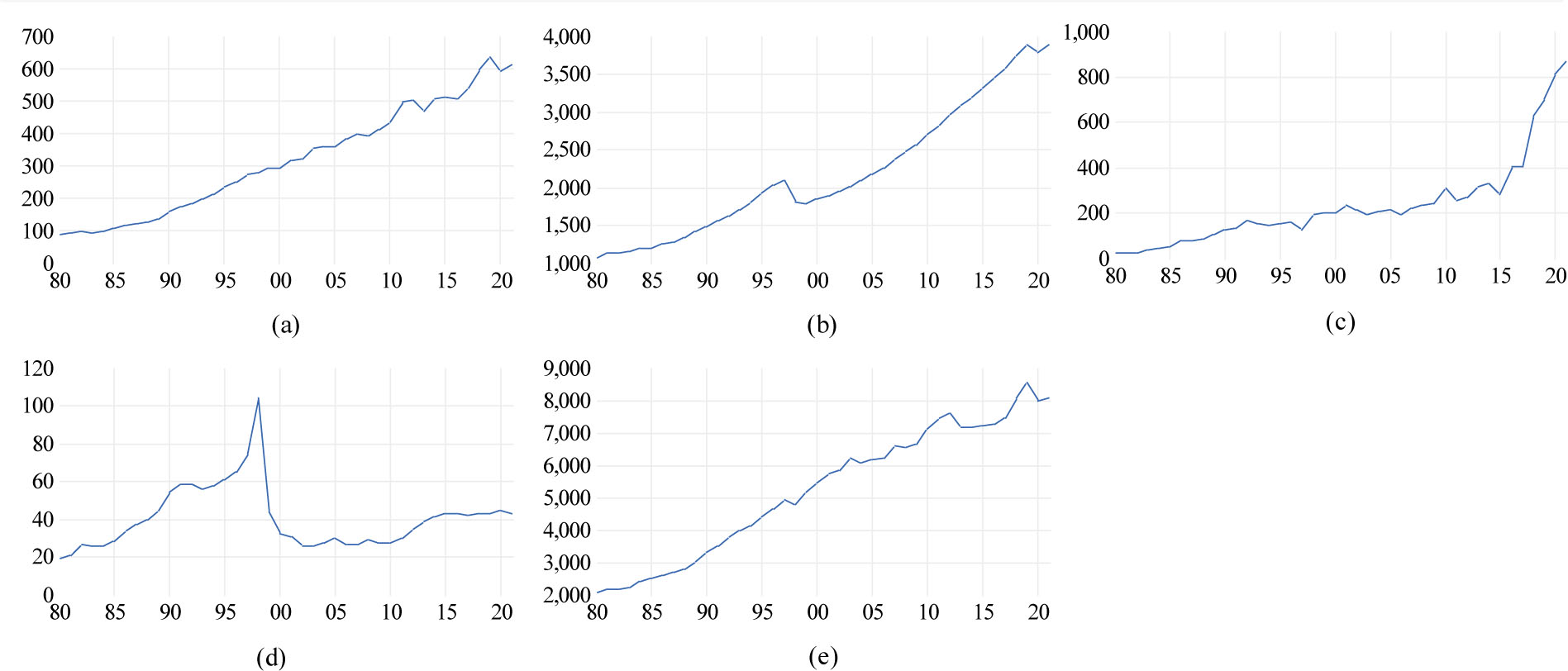
Furthermore, this study displays trends of model variables in Figure 2. CO2, YPC, ENC, and REU exhibit upward trends over the observed period. Therefore, it can be concluded that CO2, per capita GDP, per capita energy consumption, and primary energy consumption from renewable sources demonstrate increasing trends over the period 1980-2022. CRD denotes an upward trend from 1980 to 2020, after which its trajectory became more volatile, fluctuating within a band of 20 to 40 percent of GDP.
Trends of model variables: CO2 emissions (a), per capita GDP (b), primary energy consumption from renewable sources (c), total credit to the private non-financial sector (d), and per capita energy consumption (e)
Testing the order of integration is a crucial step before the application of ARDLBT. Thus, two types of stationarity tests are considered, the ADF and PP approaches. The outcomes of the ADF approach denote that all the model variables, i.e., CO2, YPC, CRD, REU, and ENC, fail to reject the null hypothesis at the level. They are non-stationary at their level. Nonetheless, CO2, YPC, CRD, REU, and ENC are stationary after the first difference is computed. Similarly, the results of the PP test demonstrate that CO2, YPC, CRD, ENC, and REU are first-order stationary, 1(1). Since none of the variables are second-order stationary, I(2), ARDLBT is a proper method for CO2 emissions modeling. Table 2 reports the combined findings of unit root tests, obtained from ADF and PP approaches.
Unit root test results
Variable |
Level |
First difference |
||
|---|---|---|---|---|
Stat. |
p-value |
Stat. |
p-value |
|
ADF test |
||||
CO2 |
-2.522 |
0.317 |
8.308 |
0.000 |
YPC |
-2.467 |
0.342 |
-4.928 |
0.001 |
CRD |
-2.047 |
0.559 |
-5.443 |
0.000 |
ENC |
-2.069 |
0.546 |
-4.911 |
0.002 |
REU |
-2.096 |
0.533 |
-7.869 |
0.000 |
| PP test | ||||
CO2 |
-2.386 |
0.381 |
-9.250 |
0.000 |
YPC |
-2.136 |
0.512 |
-4.919 |
0.002 |
CRD |
-2.139 |
0.510 |
-5.443 |
0.000 |
ENC |
-1.513 |
0.809 |
-4.027 |
0.015 |
REU |
-2.102 |
0.530 |
-7.708 |
0.000 |
Having determined the order of integration of the model variables, the next step is to assess the presence of cointegration. However, an essential preliminary step before proceeding with cointegration analysis is the identification of the optimal lag length. For this purpose, this study works with the AIC test in the model specification. Table 3 suggests that lag order 2 represents the maximum lag length.
Maximum lag length test results
Lag |
AIC |
SC |
HQ |
|---|---|---|---|
0 |
31.71 |
31.96 |
31.80 |
1 |
18.38 |
20.13* |
19.02 |
2 |
17.80* |
21.06 |
18.99* |
Using the selected lag length, the next analysis is to examine the presence of cointegration. The findings of the Bounds test are documented in Table 4. The H0 is observed to be rejected given that the estimated F-statistic (18.11) surpasses the upper bounds (4.15). Thus, it can be inferred that the cointegration relationship between CO2, YPC, YPC2, CRD, ENC, and REU is strongly confirmed.
Cointegration test results
Value |
Sign. |
I[0] |
I[1] |
|
|---|---|---|---|---|
F-stat. |
18.11 |
0.10 |
2.08 |
3.00 |
| k | 5 |
0.50 |
2.39 |
3.38 |
0.01 |
3.06 |
4.15 |
The presence of cointegration reveals that potential spurious regression is not evident. Thus, the dynamic short- and long-run estimates are meaningful to be interpreted. Table 5 displays the results of long-run parameters. YPC is negatively associated with CO2, whereas YPC2 is positively linked to CO2, denoting the absence of the EKC hypothesis. The inverse U-shaped linkage between per capita GDP and CO2 emissions is not validated. Instead, there is a U-shaped (ball-shaped) association. Economic growth initially leads to CO2 reduction, but after a certain point, it positively influences emissions. The estimated ITP is US$1,879 per capita. Although the findings contradict the EKC framework, the U-shaped relationship between income and CO2 is similar to earlier studies [52], [53]. It should be highlighted that the lack of evidence for the EKC hypothesis indicates that economic development cannot be utilized as a sole instrument for CO2 reduction.
Long-run relationships
Coeff. |
Std. Err. |
t-stat. |
p-value |
|
|---|---|---|---|---|
LnYPC |
-4.900 |
1.546 |
-3.17 |
0.003 |
LnYPC2 |
0.325 |
0.095 |
3.41 |
0.002 |
LnCRD |
0.077 |
0.025 |
3.14 |
0.004 |
LnENC |
1.455 |
0.108 |
13.47 |
0.000 |
LnREU |
-0.054 |
0.024 |
-2.28 |
0.029 |
Constant |
11.666 |
5.381 |
2.17 |
0.037 |
Total credit to the private non-financial sector is found to have a positive and significant effect on CO2 at a 1% critical value. The estimated parameter of CRD is 0.077. This implies that a 1% increase in total credit to the private non-financial sector results in a 0.077% rise in CO2, indicating an inelastic relationship. This finding suggests that credits accessed by non-financial firms contribute to environmental degradation by increasing emissions.
Credit can directly and indirectly impact emissions. A positive link between credit and CO2 indicates that the vast majority of financial credits accessed by firms are used for unsustainable business. Credits mainly contribute to air pollution through fossil fuel financing and energy-intensive industries such as mining extraction, transportation, cement, chemicals, and steel. As an emerging economy, it is difficult for Indonesia to decouple emissions from businesses that drive economic growth [39]. Another channel is that private credits induce CO2 by financing unsustainable agriculture practices, particularly those involving land use change.
Since the positive impact of credit on CO2 is evident, enhancing green financing is crucial for Indonesia. Neglecting the detrimental impact of credit may impair the endeavor to satisfy the principle of sustainable development, including the CO2 reduction target. Thus, financial products related to green credit should be promoted. Sustainable finance policies are verified to have the capacity to drive the green transformation of heavily polluting firms [54]. Green financial credit, combined with disruptive low-carbon innovation, is confirmed to significantly foster carbon reduction [55].
A further novel result is that the percentage of primary energy consumption from renewable sources is found to have a negative influence on CO2 emissions, as expected. This empirical evidence corroborates findings reported in prior investigations in the case of G-20 countries [56] and OECD members [57]. The estimated parameter of REU is -0.10604. Thus, a 1% hike in primary energy consumption from renewable sources leads to a 0.11% decrease in CO2, demonstrating an inelastic relationship.
The negative association between CO2 and clean energy gives an insight into the pivotal role of the Renewable Energy Transition (RET). Higher clean energy consumption corresponds to lower emissions produced. The bright side is that Indonesia has a massive potential for clean energy development, including solar PV, geothermal, wind power, bioenergy, and hydropower [58]. As mentioned in the National Energy Policy (NEP) 2014, Indonesia intends to have 23% of its energy mix supplied by clean sources by 2025 [59].
Regarding control variables, per capita total energy consumption is positively associated with CO2, while, surprisingly, trade openness is negatively linked to CO2. The damaging impact of energy consumption on the environment is verified, consistent with several earlier studies [60], [61]. This evidence emphasizes that the vast majority of energy generators in Indonesia are derived from fossil fuel sources. Next, the negative connection between trade openness and emissions suggests that export and import activities have the ability to support environmental sustainability by lowering emissions. This finding is consistent with previous works reported in Europe [62] and Indonesia [63].
The results of the short-run and the ECT parameters are displayed in Table 6. The short-run estimates denote that the EKC hypothesis is validated. The linkage between per capita GDP and CO2 reveals the inverse U-shaped pattern in the short run. Another novel finding is that private credit to non-financial sectors positively affects CO2. Therefore, it can be inferred that increased access to borrowing contributes to environmental degradation by raising CO2 levels. This evidence emphasizes the crucial need for green credit products.
Short-run relationships
Coeff. |
Std. Err. |
t-stat. |
p-value |
|
|---|---|---|---|---|
∆LnYPC |
-3.927 |
1.357 |
-2.89 |
0.007 |
∆LnYPC2 |
0.261 |
0.085 |
3.08 |
0.004 |
∆LnCRD |
0.062 |
0.020 |
3.03 |
0.005 |
∆LnREU |
1.166 |
0.155 |
7.54 |
0.000 |
∆LnENC |
-0.043 |
0.020 |
-2.18 |
0.036 |
ECT |
-0.801 |
0.082 |
-9.77 |
0.000 |
Other short-run estimates demonstrate that renewable energy holds a pivotal position in promoting sustainable development since it is negatively associated with emissions, consistent with the long-run estimates. Conversely, per capita total energy consumption has a detrimental impact on the environment, given that it is positively linked with CO2, as predicted. These results imply that clean energy can be applied as a key instrument for pollution reduction. Thus, it can be stated that promoting RET is a crucial scheme for reducing the level of emissions.
The ECT parameter is confirmed to be negative, consistent with theoretical expectations. It is statistically significant at a 1% level. The estimated parameter of ECT is -0.801. This result suggests that short-run shocks that cause deviations are adjusted by around 80% within a year toward the long-run equilibrium. This evidence corroborates the evidence of cointegration as reported by the Bounds test.
This study includes diagnostic tests to ensure reliable findings derived from the ARDLBT. Table 7 jointly displays the outcomes of the diagnostic tests. Following the Breusch-Godfrey and Breusch-Pagan analyses, issues regarding serial correlation and heteroskedasticity are not evident. Instead, error terms are not serially correlated and are homoscedastic. Furthermore, the Ramsey RESET test signifies no clear signs of model misspecification. The JB test signifies that error terms exhibit a normal distribution. Therefore, these diagnostic results provide strong statistical support that the estimated ARDLBT model is robust and reliable for inference.
Diagnostic test results
Test |
H0 |
Stat. |
p-value |
|---|---|---|---|
Breusch-Godrey |
No serial correlation |
1.063 |
0.303 |
Breusch–Pagan-Godfrey |
Constant variance |
2.690 |
0.101 |
Ramsey RESET |
No omitted variable |
0.360 |
0.779 |
Jaeque-Bera |
Normality residuals |
0.335 |
0.846 |
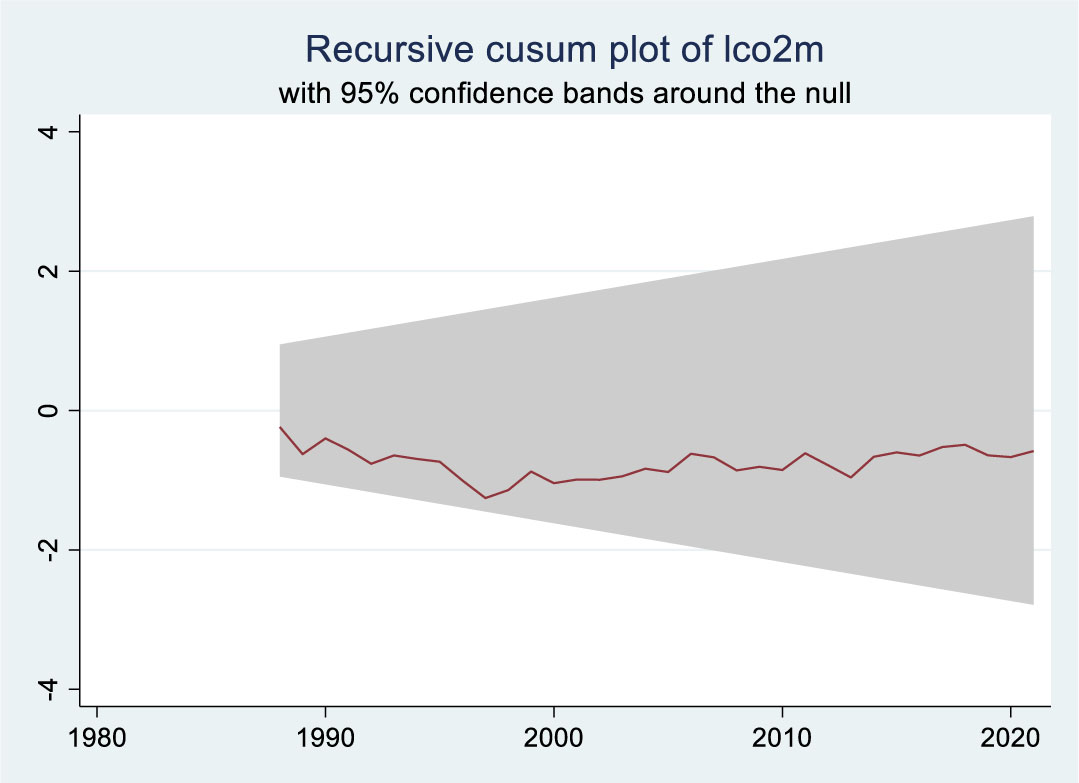
In addition to diagnostic tests, this study includes the stability parameter test by employing the cumulative sum (CUSUM) test of recursive residuals. The null hypothesis of parameter consistency is proposed. As shown in Figure 3, the cumulative sums (red plots) fluctuate within the critical lines at a 95% level. Thus, it can be stated that the ARDLBT (1,0,0,0,0,0) model is stable during the period of analysis. In other words, a structural break is not evident.
cumulative sum test results
To check the robustness of the estimated parameters obtained from ARDLBT, this study employs the Fully Modified OLS (FMOLS). The FMOLS estimator is chosen given that it has the power to tackle serial correlation and endogeneity [64]. Furthermore, it is more relaxed in terms of the order of integration and nonstationary series. Table 8 displays the results of the FMOLS estimation. The computed coefficients from FMOLS exhibit consistency with the long-run estimates obtained from the ARDLBT procedure. There is a U-shaped pattern for the linkage between income and emissions, suggesting the absence of the EKC hypothesis. Other findings denote a positive connection between private credit, per capita energy consumption, and CO2, as well as an adverse association between clean energy and CO2. Hence, it can be inferred that the empirical findings in this study are robust and reliable.
Fully Modified Ordinary Least Squares estimation results
Coeff. |
Std. Err. |
t-stat. |
p-value |
|
|---|---|---|---|---|
LnYPC |
-3.751 |
1.647 |
-2.277 |
0.029 |
LnYPC2 |
0.263 |
0.102 |
2.583 |
0.014 |
LnCRD |
0.062 |
0.030 |
2.063 |
0.046 |
LnREU |
-0.102 |
0.031 |
-3.304 |
0.002 |
LnENC |
0.906 |
0.124 |
7.316 |
0.000 |
Constant |
6.167 |
5.714 |
1.079 |
0.288 |
R-square |
0.991 |
The ARDLBT analyses do not imply the causal direction between the variables. Therefore, with the lag order set to one, this study performs the GC test, and the corresponding results are collectively presented in Table 9. This study focuses on the causal relationships related to CO2. There is a bidirectional causality between CO2 and YPC. In practical terms, this implies that variations in per capita income significantly influence the level of CO₂, as higher income levels are often associated with increased fossil fuel consumption, industrial activities, and shifts in consumption patterns that lead to greater emissions.
Causality test results
(x Granger Causes y) |
Chi-square |
p-value |
|---|---|---|
LnCO2←lnYPC |
12.655 |
0.005 |
LnYPC←LnCO2 |
8.936 |
0.030 |
LnCO2←LnCRD |
6.311 |
0.097 |
LnCRD←LnCO2 |
11.130 |
0.011 |
LnCO2←LnENC |
15.401 |
0.002 |
LnENC←LnCO2 |
5.927 |
0.115 |
LnCO2←LnREU |
6.661 |
0.084 |
LnREU←LnCO2 |
0.252 |
0.969 |
LnYPC←LnCRD |
11.729 |
0.008 |
LnCRD←LnYPC |
81.562 |
0.000 |
LnYPC←LnENC |
15.278 |
0.002 |
LnENC←LnYPC |
8.014 |
0.046 |
LnYPC←LnREU |
24.391 |
0.000 |
LnREU←LnYPC |
6.355 |
0.096 |
LnCRD←LnENC |
8.732 |
0.033 |
LnENC←LnCRD |
13.326 |
0.004 |
LnCRD←LnREU |
21.935 |
0.000 |
LnREU←LnCRD |
4.903 |
0.179 |
LnENC←LnREU |
10.470 |
0.015 |
LnREU←LnENC |
1.9346 |
0.586 |
Another novel finding denotes the presence of a bidirectional causal nexus between CO2 and CRD, as expected. The feedback relationship between emissions and total private credit to nonfinancial firms demonstrates that the past value of emissions impacts the amount of loans accessed by firms. This evidence is relevant since pollutions are associated with transactional, physical, and reputational risks.
Furthermore, the results of the GC test signify a unidirectional causal linkage moving from per capita energy consumption toward CO2. This finding emphasizes that energy consumption is a significant driver of environmental deterioration by increasing emissions, corroborating the evidence obtained from the ARDLBT model. Higher per capita energy usage corresponds to a greater release of CO2.
Last of all, there is unidirectional causality moving from primary energy consumption from renewable resources toward CO2. This evidence implies that clean energy exerts a measurable influence in facilitating CO2 reduction, whereas changes in CO2 levels do not have a reciprocal effect on the utilization of clean energy. In this regard, advancing green energy infrastructure, in conjunction with promoting energy efficiency and implementing low-carbon technologies, constitutes an essential prerequisite for facilitating Indonesia’s transition toward a sustainable development trajectory.
Whether private credit is necessary for supporting emissions reduction is a pivotal question to be addressed, simultaneously with the impact of energy consumption and economic growth. This study augments the EKC model, taking a unique perspective by integrating the impact of total credit to private non-financial sectors and renewable energy consumption in the context of Indonesia by employing annual data over the period 1980 to 2020. The ARDLBT approach is utilized to provide the dynamic and cointegration relationships, followed by the GC test for unraveling causal directions.
The results from regressions convey that the validity of the EKC hypothesis is not verified; instead, there is a ball-shaped association between income and CO2, suggesting that economic growth cannot be solely considered an instrument for emission reduction. Total credit to non-financial sectors is found to significantly influence environmental degradation by raising CO2, indicating that emissions are expected to arise from financial developments. Primary energy use from renewable sources is confirmed to be negatively associated with CO2, emphasizing the significance of the clean energy transition in promoting sustainable development. The GC test suggests a feedback relationship between economic growth, private credit, and CO2, as well as a unidirectional causality flowing from per capita energy consumption toward CO2. In light of the findings, the promotion of green financial products and the reduction of dependence on fossil fuel consumption through the adoption of renewable energy are pivotal.
- ,
Sustainable development by carbon emission reduction and its quantification: an overview of current methods and best practices ,Asian J. Civ. Eng. , Vol. 24 (8), :3797-38222023, https://doi.org/10.1007/s42107-023-00732-z - , Climate Transparency Report: Comparing G20 Climate Action, 2022
- ,
Challenges and Prospects for Agricultural Greenhouse Gas Mitigation Pathways Consistent With the Paris Agreement ,Front. Sustain. Food Syst. , Vol. 4 , :1-82020, https://doi.org/10.3389/fsufs.2020.00069 - ,
Environmental Stewardship and Economic Prosperity: A Comprehensive Assessment of CO2 Emissions and Sustainable Development Goals in European Countries ,J. Knowl. Econ. , 2024, https://doi.org/10.1007/s13132-024-02169-4 - ,
The Rising Threat of Atmospheric CO2: A Review on the Causes, Impacts, and Mitigation Strategies ,Environ. - MDPI , Vol. 10 (4), :662023, https://doi.org/10.3390/environments10040066 - ,
Reinvestigate the significance of STRIPAT and extended STRIPAT: An inclusion of renewable energy and trade for gulf council countries ,Energy Environ. , 0958305X2311816712023, https://doi.org/10.1177/0958305X231181671 - ,
Rural–urban transformation, energy consumption, economic growth, and CO2 emissions using STRIPAT model for BRICS countries ,Environ. Prog. Sustain. Energy , Vol. 36 (2), :523-5312017, https://doi.org/10.1002/ep.12461 - ,
Nuclear energy, economic growth and CO2 emissions in Pakistan: Evidence from extended STRIPAT model ,Nucl. Eng. Technol. , 2024, https://doi.org/10.1016/j.net.2024.02.006 - ,
Nexus between Blue Economy, Renewable Energy and Environmental Sustainability in the MENA Region: Evidence from Panel Threshold Regression ,Int. J. Energy Econ. Policy , Vol. 14 (4), :169-1852024, https://doi.org/10.32479/ijeep.16125 - ,
The econometrics of the environmental Kuznets curve: an illustration using Australian CO2 emissions ,Appl. Econ. , Vol. 49 (49), :4927-49452017, https://doi.org/10.1080/00036846.2017.1296552 - ,
Revisiting Environmental Kuznets Curve in Sub-Sahara Africa ,Int. J. Soc. Econ. , Vol. 44 (2), :222-2312017, https://doi.org/10.1108/IJSE-02-2015-0034 - ,
Revisiting the environmental kuznets curve hypothesis in 208 counties: The roles of trade openness, human capital, renewable energy and natural resource rent ,Environ. Res. , Vol. 216 , :1146372023, https://doi.org/10.1016/j.envres.2022.114637 - ,
The invisible hand and EKC hypothesis: what are the drivers of environmental degradation and pollution in Africa? ,Environ. Sci. Pollut. Res. , Vol. 25 (22), :21993-220222018, https://doi.org/10.1007/s11356-018-2347-x - ,
Does environmental Kuznets curve hypothesis exist? Evidence from dynamic panel threshold ,J. Environ. Econ. Policy , Vol. 7 (2), :145-1652018, https://doi.org/10.1080/21606544.2017.1382395 - ,
Testing validity of the EKC hypothesis in South Korea: role of renewable energy and trade openness ,Environ. Sci. Pollut. Res. , Vol. 27 (23), :29043-290542020, https://doi.org/10.1007/s11356-020-09172-7 - ,
CO2 emissions, energy consumption and economic growth in the ASEAN-5 countries: A cross-sectional dependence approach ,Energy Econ. , Vol. 85 , :1045712020, https://doi.org/10.1016/j.eneco.2019.104571 - ,
The ambivalent role of institutions in the CO2 emissions: The case of emerging countries ,Int. J. Energy Econ. Policy , Vol. 8 (5), :7-172018 - ,
Environmental kuznets curve (EKC): Empirical relationship between economic growth, energy consumption, and co2 emissions: Evidence from 3 developed countries ,Panoeconomicus , Vol. 68 (4), :483-5062021, https://doi.org/10.2298/PAN180503004B - ,
Carbon Emissions and the Bank-Lending Channel ,SSRN Electron. J. , 2021, https://doi.org/10.2139/ssrn.3915486 - ,
The challenges of maturity mismatch in investment and financing for sustainable development of carbon-intensive enterprises ,Environ. Sci. Pollut. Res. , Vol. 30 (44), :99541-995602023, https://doi.org/10.1007/s11356-023-29445-1 - ,
The carbon dioxide emission effects of domestic credit and manufacturing indicators in South Africa ,Manag. Environ. Qual. An Int. J. , Vol. 31 (6), :1531-15482020, https://doi.org/10.1108/MEQ-11-2019-0245 - ,
Analysis on the nexus of CO2 emissions, energy use, net domestic credit, and GDP in Pakistan: an ARDL bound testing analysis ,Environ. Sci. Pollut. Res. , Vol. 28 (4), :4594-46142021, https://doi.org/10.1007/s11356-020-10763-7 - , , An autoregressive distributed lag modelling approach to cointegration analysis, 1995
- ,
Economic Activities and Management Issues for the Environment: An Environmental Kuznets Curve (EKC) and STIRPAT Analysis in Turkey ,Resources , Vol. 12 (5), :572023, https://doi.org/10.3390/resources12050057 - ,
The evolution of the environmental Kuznets curve hypothesis assessment: A literature review under a critical analysis perspective ,Heliyon , Vol. 8 (11), :e115212022, https://doi.org/10.1016/j.heliyon.2022.e11521 - ,
Environmental sustainability and economic development in sub-Saharan Africa: A modified EKC hypothesis ,Renew. Sustain. Energy Rev. , Vol. 143 , :1108972021 - ,
The Environmental Kuznets Curve (EKC) theory-Part A: Concept, causes and the CO2 emissions case ,Energy Policy , Vol. 62 , :1392-14022013, https://doi.org/10.1016/j.enpol.2013.07.131 - ,
Deforestation-induced the EKC framework : The role of corruption control and trade openness in Southeast Asia , Vol. 24 , 2023, https://doi.org/10.18196/jesp.v24i1.16798 - ,
Economic growth and environmental pollution in Myanmar: an analysis of environmental Kuznets curve ,Environ. Sci. Pollut. Res. , Vol. 24 (25), :20487-205012017, https://doi.org/10.1007/s11356-017-9567-3 - ,
Does the Linkage between GDP, Renewable Energy, and Methane Validate the EKC hypothesis? Evidence from Indonesia ,Int. J. Energy Econ. Policy , Vol. 14 (2), :711-7202024, https://doi.org/10.32479/ijeep.15075 - ,
An Environmental Kuznets Curve for water pollution: Does water abundance affect the turning point? ,Sci. Total Environ. , Vol. 913 , :1696572024, https://doi.org/10.1016/j.scitotenv.2023.169657 - ,
Environmental Kuznets curve for biodiversity loss: evidence from South and Southeast Asian countries. ,Environ. Sci. Pollut. Res. Int. , Vol. 29 (42), :64004-640212022, https://doi.org/10.1007/s11356-022-20090-8 - ,
Testing the long-run impact of economic growth, energy consumption, and globalization on ecological footprint: new evidence from Fourier bootstrap ARDL and Fourier bootstrap Toda–Yamamoto test results ,Environ. Sci. Pollut. Res. , Vol. 30 (15), :42873-428882023, https://doi.org/10.1007/s11356-022-18610-7 - ,
Role of renewable energy and non-renewable energy consumption on EKC: Evidence from Pakistan ,J. Clean. Prod. , Vol. 156 , :855-8642017, https://doi.org/10.1016/j.jclepro.2017.03.203 - ,
Reduction of CO2 emissions : The role of renewable energy , technological innovation and export quality ,Energy Reports , Vol. 8 , :2793-28052022, https://doi.org/10.1016/j.egyr.2022.01.200 - ,
Testing the EKC Hypothesis in Indonesia: Empirical Evidence from the ARDL-Based Bounds and Wavelet Coherence Approaches ,Asian J. Appl. Econ. , Vol. 28 (1), :78-1002020https://so01.tci-thaijo.org/index.php/AEJ/article/view/242922 - ,
Re-visiting the Environmental Kuznets curve for ASEAN: A comparison between ecological footprint and carbon dioxide emissions ,Renew. Sustain. Energy Rev. , Vol. 168 , :1128672022, https://doi.org/10.1016/j.rser.2022.112867 - ,
Effect of economic growth on CO2 emission in developing countries: Evidence from a dynamic panel threshold model ,Cogent Econ. Financ. , Vol. 5 (1), :13792392017, https://doi.org/10.1080/23322039.2017.1379239 - ,
The decoupling dilemma: Examining economic growth and carbon emissions in emerging economic blocs ,Energy Econ. , Vol. 138 , :1078482024, https://doi.org/10.1016/j.eneco.2024.107848 - ,
Impact of urbanization and economic growth on environmental quality in western africa: Do manufacturing activities and renewable energy matter? ,Front. Environ. Sci. , Vol. 10 , :1-122022, https://doi.org/10.3389/fenvs.2022.1012007 - ,
Renewable Energy, Urbanization, and CO2 Emissions: A Global Test ,Energies , 1-132022, https://doi.org/10.3390/en15093390 - ,
Is growth of the financial sector relevant for mitigating CO2 emissions in Bangladesh? The moderation role of the financial sector within the EKC model ,Environ. Dev. Sustain. , Vol. 25 (9), :9567-95882023, https://doi.org/10.1007/s10668-022-02447-8 - ,
Financial Development, CO2 Emissions, Fossil Fuel Consumption and Economic Growth: The Case of Turkey ,Strateg. Plan. Energy Environ. , Vol. 38 (4), :7-282019, https://doi.org/10.1080/10485236.2019.12054409 - ,
Examining the direct and indirect effects of financial development on CO2 emissions for 88 developing countries ,J. Environ. Manage. , Vol. 293 , :1128122021, https://doi.org/10.1016/j.jenvman.2021.112812 - ,
The nexus between economic growth, financial development, trade openness, and CO2 emissions in European countries ,Cogent Econ. Financ. , Vol. 5 (1), :13414562017, https://doi.org/10.1080/23322039.2017.1341456 - ,
Re-visiting the environmental Kuznets curve hypothesis for Malaysia: Fresh evidence from ARDL bounds testing approach ,Renew. Sustain. Energy Rev. , Vol. 77 , :990-10002017, https://doi.org/10.1016/j.rser.2016.11.236 - ,
Economic growth and deforestation in African countries: Is the environmental Kuznets curve hypothesis applicable? ,For. Policy Econ. , Vol. 129 , :1024882021, https://doi.org/10.1016/j.forpol.2021.102488 - ,
Testing for Unit Roots in Autoregressive-Moving Average Models of Unknown Order ,Biometrika , Vol. 71 (3), :599-6071984, https://doi.org/10.2307/2336570 - ,
Bounds testing approaches to the analysis of level relationships ,J. Appl. Econom. , Vol. 16 (3), :289-3262001, https://doi.org/10.1002/jae.616 - ,
Energy prices and economic performance in South Africa: an ARDL bounds testing approach ,Cogent Econ. Financ. , Vol. 10 (1), :20699052022, https://doi.org/10.1080/23322039.2022.2069905 - ,
Investigating Causal Relations by Econometric Models ,Econometrica , Vol. 37 (3), :424-4381969https://www.jstor.org/stable/1912791 - ,
The impact of economic structure to the environmental Kuznets curve (EKC) hypothesis: evidence from European countries ,Environ. Sci. Pollut. Res. , Vol. 27 (11), :12717-127242020, https://doi.org/10.1007/s11356-020-07878-2 - ,
CO2 emissions, real output, energy consumption, trade, urbanization and financial development: testing the EKC hypothesis for the USA ,Environ. Sci. Pollut. Res. , Vol. 23 (2), :1203-12132016, https://doi.org/10.1007/s11356-015-5323-8 - ,
The impact of green credit on green transformation of heavily polluting enterprises: Reverse forcing or forward pushing? ,Energy Policy , Vol. 184 , :1139012024, https://doi.org/10.1016/j.enpol.2023.113901 - ,
How Does Green Credit Promote Carbon Reduction? A Mediated Model ,Front. Environ. Sci. , Vol. 10 , :1-102022, https://doi.org/10.3389/fenvs.2022.878060 - ,
Do remittance and renewable energy affect CO2 emissions? An empirical evidence from selected G-20 countries ,Energy Environ. , Vol. 33 (5), :916-9322021, https://doi.org/10.1177/0958305X211029636 - ,
Reducing CO2 emissions in OECD countries: Do renewable and nuclear energy matter? ,Prog. Nucl. Energy , Vol. 126 , :1034252020, https://doi.org/10.1016/j.pnucene.2020.103425 - ,
Review of Renewable Energy Potentials in Indonesia and Their ,Energies , Vol. 14 (21), :70332021, https://doi.org/10.3390/en14217033 - , Indonesia’s expansion of clean power can spur growth and equality, 2024
- ,
The Damaging Growth: An Empiric Evidence of Environmental Kuznets Curve in Indonesia ,Int. J. Energy Econ. Policy , Vol. 9 (5), :339-3452019, https://doi.org/10.32479/ijeep.7816 - ,
Nuclear energy, renewable energy, CO2 emissions, and economic growth for nine developed countries: Evidence from panel Granger causality tests ,Prog. Nucl. Energy , Vol. 88 , :364-3742016, https://doi.org/10.1016/j.pnucene.2016.01.018 - ,
Determinants of CO2 emissions in the European Union: The role of renewable and non-renewable energy ,Renew. Energy , Vol. 94 , :429-4392016, https://doi.org/10.1016/j.renene.2016.03.078 - ,
The Enviromental Kuznets Curve Hypothesis: an Empirical Evidence in Indonesia ,J. Econ. Policy , Vol. 15 (1), :207-2202022 - ,
Greenhouse gas emissions, energy consumption and economic growth: A panel cointegration analysis from Canadian industrial sector perspective ,Energy Econ. , Vol. 34 (1), :358-3642012, https://doi.org/10.1016/j.eneco.2011.06.005